The complete guide
Reverse osmosis for renters: what you get and what you give up
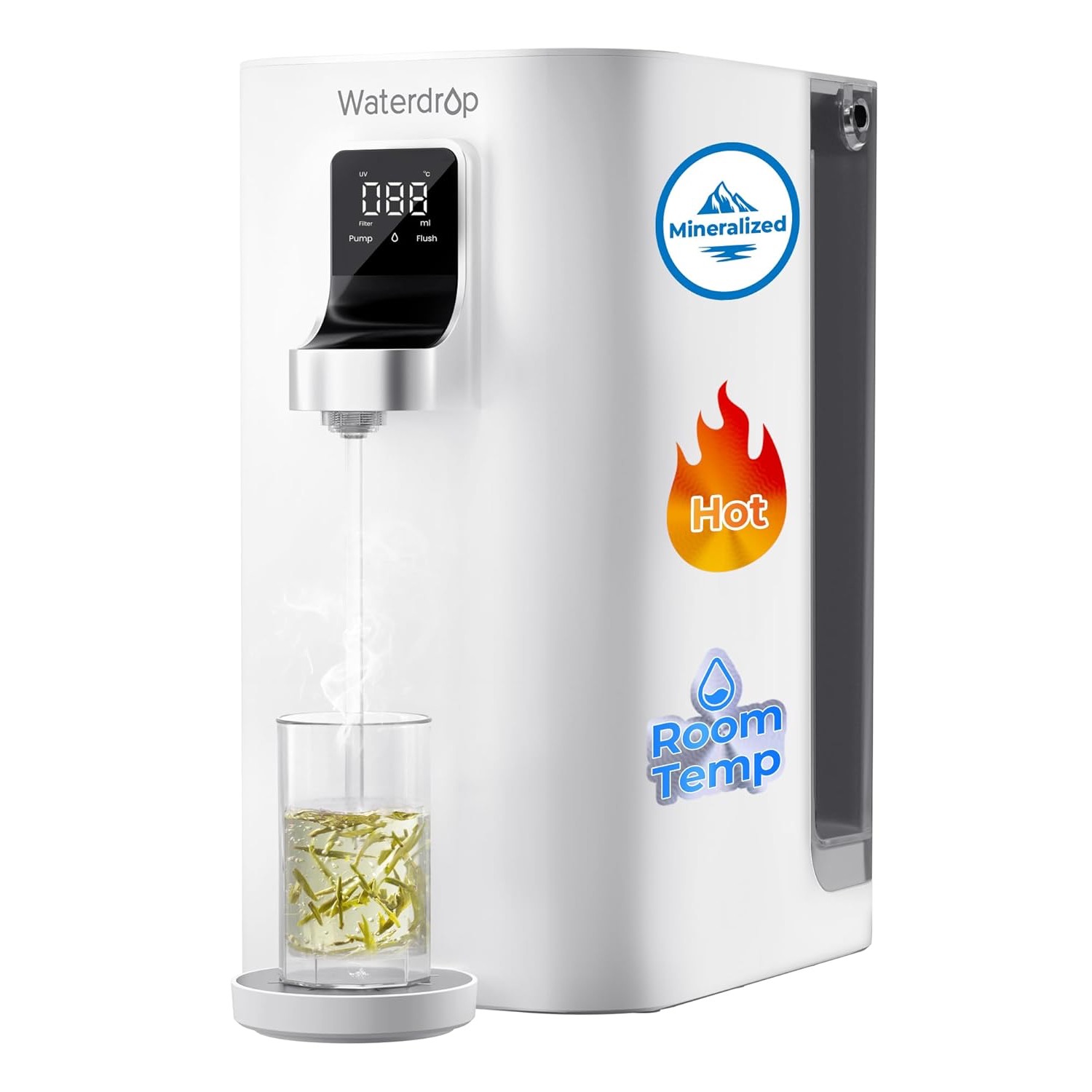
Reverse osmosis is the strongest domestic water treatment available, and for most of its history it has been effectively unavailable to anyone who does not own their home. Countertop units change that, with a couple of genuine trade-offs worth understanding before you spend £369.
How reverse osmosis differs from everything else here
Every other filter in this catalogue works by adsorption or exchange. Carbon holds contaminants on its surface; ion-exchange resin swaps ions with the water. Both are selective, and both are limited to what the media can grab.
RO is mechanical. Water is pushed under pressure against a semi-permeable membrane whose pores are around 0.0001 microns across. Water molecules pass. Almost everything larger — dissolved salts, metals, fluoride, nitrate, PFAS compounds — does not.
That is why RO can address contaminants no carbon filter touches, and why it is the only thing in this range that meaningfully reduces TDS.
What it takes out, and what that costs
The strength is also the weakness. A membrane cannot tell a nitrate ion from a calcium one. It removes the things you are worried about and the minerals that make water taste like water, which is why RO water straight off the membrane tastes flat and hollow.
Well-designed systems fix this by remineralising — adding a controlled amount of mineral content back after the membrane. This one adds potassium, calcium, sodium and magnesium. If you are ever offered an RO system without a remineralisation stage, taste the output before you commit.
The countertop trade-off: reject water
Here is the thing worth knowing before buying, because it rarely appears in the headline features.
RO works by separating the feed water into two streams: purified water and a concentrate carrying the rejected contaminants. A plumbed-in system sends that concentrate straight down the waste pipe and you never think about it.
A countertop system has nowhere to send it, so it collects it in an internal reservoir that you empty. It is not difficult, but it is a recurring task, and it is the honest price of not drilling a hole in your kitchen. Anyone who tells you a countertop RO system has no waste stream is describing a different technology.
Why this suits renters specifically
- Nothing is modified. No drilling, no cut pipework, no tap fitted into the worktop. Nothing to make good at the end of a tenancy.
- It moves with you. It is an appliance, not a fixture, and at 8.5 kg it goes in a box with everything else.
- No permission needed. There is nothing in a standard tenancy agreement that covers plugging in a kitchen appliance.
- No plumber. The installation cost of a plumbed RO system frequently approaches the cost of the system.
Who should not buy this
- Serious coffee people. Very low mineral water extracts poorly. The remineralisation helps, but if espresso is your priority a carbon filter like the Philips dispenser is the better choice.
- Anyone whose actual complaint is chlorine taste. That is a £25 problem, and the Lucid jug solves it.
- Small kitchens. At 39.4 x 23.4 x 46.5 cm this is a serious piece of worktop furniture.
- Anyone wanting hardness reduction only. The ED06W does that for £44.99.
Buy RO when you want the broadest possible reduction — PFAS, fluoride, arsenic, nitrate, heavy metals — and you have both the space and a specific reason. It is the right answer to a narrow question, and an expensive answer to a broad one.