The complete guide
Limescale, kettles and coffee machines: what filtering actually protects
The strongest practical argument for a water filter in a British kitchen is not about what you drink. It is about what you are pouring into appliances that cost several hundred pounds.
Where limescale comes from
Scale is dissolved calcium and magnesium coming out of solution when water is heated. The hotter the water and the more it evaporates, the more mineral is left behind as calcium carbonate — the white crust on a kettle element.
This matters because the appliances most affected are the ones you heat water in repeatedly and never think about:
- Kettles. Scale on the element insulates it, so it draws power for longer to reach the same temperature.
- Espresso machines. The worst case. Scale forms inside a narrow boiler and narrower pipework, which changes brew temperature stability and eventually blocks the group.
- Bean-to-cup machines. Same problem, with more places for it to hide.
- Steam irons and steam ovens, for the same reason.
What filtering does and does not achieve
Carbon filtration reduces the mineral load going into the appliance. It does not remove it. So the honest framing is:
A filter slows the rate at which scale accumulates. It does not abolish scale, and it does not remove scale that is already there.
Anyone selling you the second claim is overselling. What you get is a longer gap between descaling cycles and less severe build-up when you do.
It also changes the taste of what comes out. Chlorine survives boiling well enough to be noticeable in tea, and it interacts badly with the aromatic compounds in coffee. Filtering before brewing is standard practice among people who take coffee seriously, and it costs nothing to adopt.
The espresso machine caveat
If you own an espresso machine, do not go too far. Coffee extraction needs some mineral content — water with almost nothing dissolved in it extracts flat, hollow coffee and can be corrosive to boilers. The Specialty Coffee Association target sits around 50–175 mg/L total dissolved solids.
This is a genuine argument in favour of carbon filtration over reverse osmosis for coffee. Carbon filters reduce chlorine and some hardness while leaving mineral content largely intact. An RO system strips it, and serious RO users remineralise afterwards for exactly this reason. If coffee is why you are filtering, this dispenser is a better fit than the K19-HG reverse osmosis system.
Still descale on a schedule
Filtered or not, put it in the calendar:
| Water hardness | Kettle | Coffee machine |
|---|---|---|
| Soft | Every 3–4 months | Per manufacturer |
| Moderately hard | Every 2 months | Every 2–3 months |
| Hard or very hard | Monthly | Monthly to 6 weeks |
Filtering shifts you roughly one row up that table. It does not let you leave the table.
Where this dispenser fits
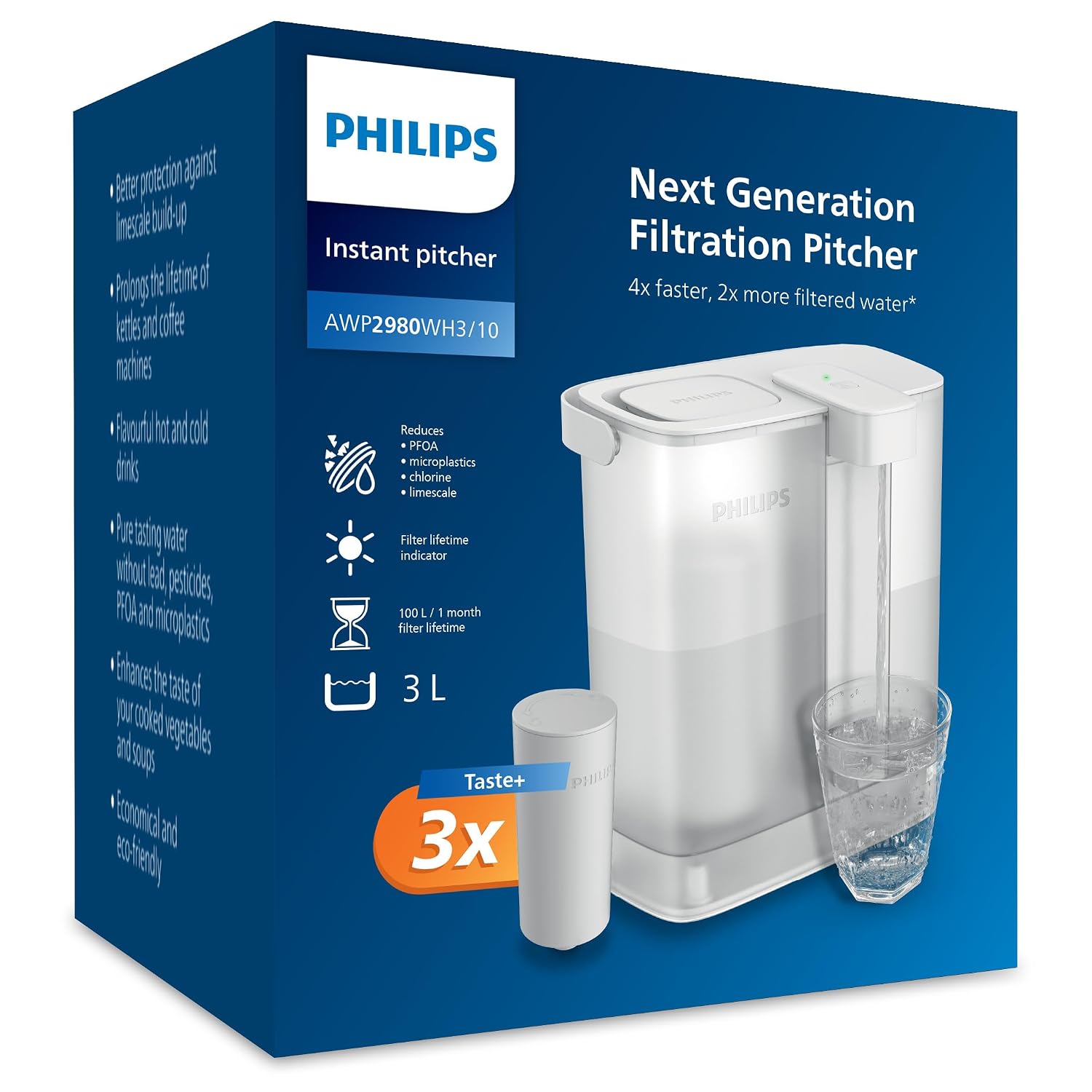
Its particular advantage is that filtration happens as you pour, so the water in the tank keeps its residual chlorine while it is stored and only becomes filtered water at the point of use. If you fill a kettle from it twice a day, you are getting freshly filtered water each time rather than water that was filtered on Tuesday. For hardness specifically, the ED06W goes further.