The complete guide
TDS explained: what the number means and when to care
TDS meters are cheap, popular, and responsible for a great deal of confusion. The number they give you is real. What most people think it means is not.
What TDS measures
Total Dissolved Solids is the combined weight of everything dissolved in water, in milligrams per litre. A handheld meter does not actually measure that — it measures electrical conductivity and converts it, on the assumption that more dissolved ions means more conductivity.
That assumption is broadly sound and completely blind to composition. Which leads to the central point:
A TDS reading tells you how much is dissolved in your water. It tells you nothing about what.
Why that matters
Consider two glasses, both reading 250 ppm:
- One is spring water: calcium, magnesium and bicarbonate. Pleasant, mineral, the sort of thing sold in bottles at a premium.
- One is water that has picked up something you would rather not drink.
Identical number, entirely different water. Conversely, some of the contaminants people worry about most — certain pesticides, PFAS compounds, some bacteria — are present at concentrations far too low to shift a TDS reading at all. A low TDS number is not a clean bill of health.
Typical figures
| Reading (ppm) | What it usually means |
|---|---|
| 0–50 | RO or distilled; very low mineral content, tastes flat |
| 50–150 | Soft water; light and clean |
| 150–300 | Typical UK mains; the range most people find pleasant |
| 300–500 | Hard water; noticeable body, scale-forming |
| 500+ | Very hard; chalky, heavy scaling |
UK mains water is legally capped at 2,500 µS/cm conductivity, which is roughly 1,500 ppm, and virtually all supplies sit far below that. If your meter reads 250, you have ordinary British tap water.
When TDS reduction is worth paying for
Reducing TDS is a real benefit in specific cases:
- Very hard water where the mineral load genuinely affects taste and scales everything it touches.
- Steam appliances and humidifiers, which run better on low-mineral water.
- A supply you have specific reason to distrust, though in that case you want a proper water quality test, not a conductivity meter.
And when it is not worth it: if your water is in the 150–300 range and tastes fine, chasing a lower number is chasing a statistic. Removing minerals makes water taste flatter, which is why RO systems add them back.
The selective middle ground
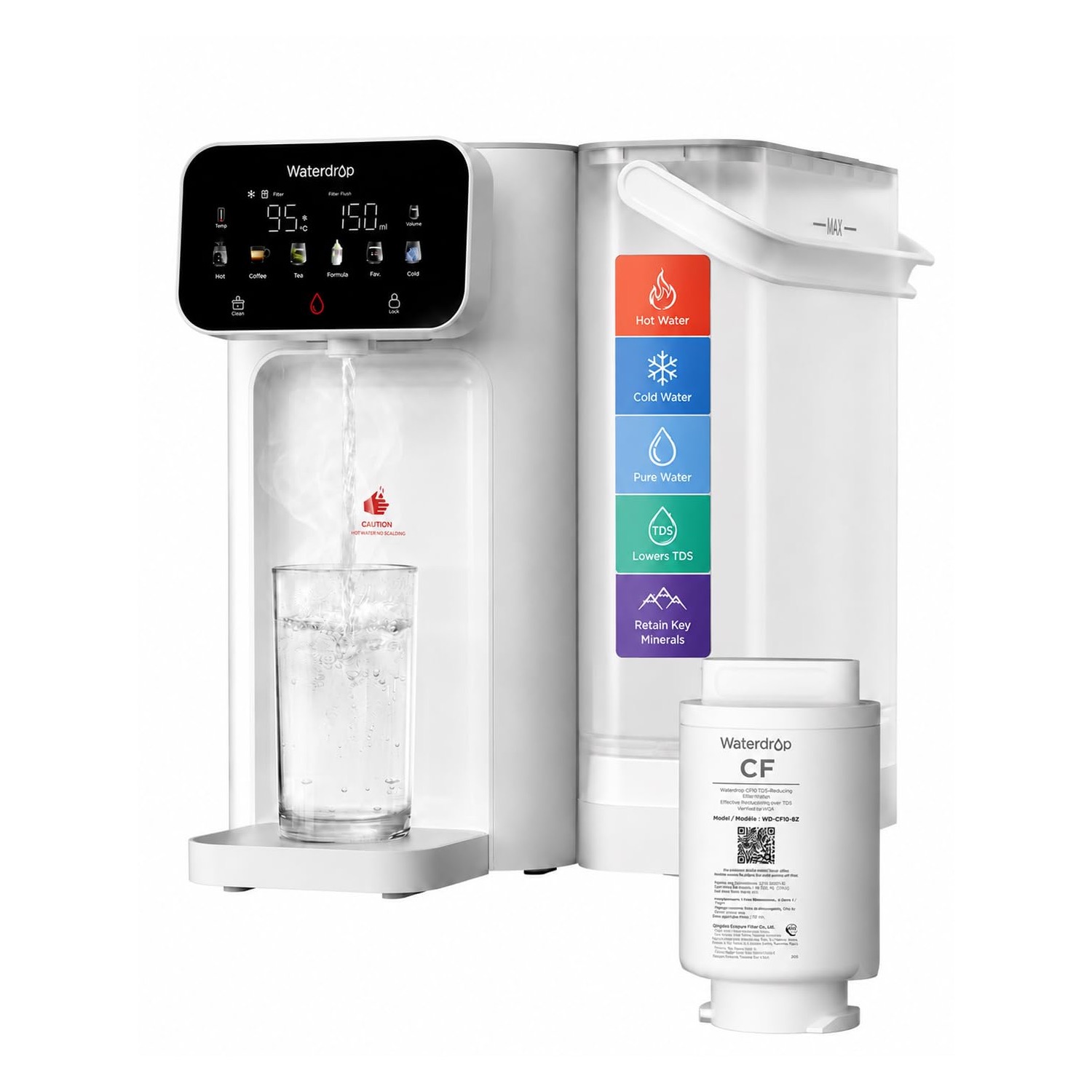
This is where the CT01 sits. Rather than stripping everything and remineralising, its eight stages are specified to bring dissolved solids and limescale down while retaining calcium, magnesium, sodium and potassium. You get less of the heaviness and the scale, and keep the character.
That is a less dramatic result than full reverse osmosis, and deliberately so. If your water is very hard, or you have a specific contaminant concern that demands maximum reduction, RO is the correct tool. If your complaint is that tap water tastes heavy and furs the kettle, this does the job without making your water taste of nothing.
Before you buy a TDS meter
If you want to know what is actually in your water, your supplier publishes a full annual water quality report for your postcode, listing individual substances against regulatory limits. It is free, it is far more informative than a conductivity reading, and it takes about two minutes to find.